My Cart (0)
- April 23, 2020
TRANSFORMATIVE AESTHETIC PROCESS THE SEARCH AS A CHALLENGE
The problematic of appropriate paradigm and critical apparatus in the study of contemporary African art are significant. The group on the receiving end of the effects of this problem and having the difficulty establishing a role and space in artistic landscape of Africa appears to be college-images and skills from universal repertoire that go beyond any geographical and cultural boundary. This undoubtedly has made a number of Africanist scholars; particularly William Fagg reject them and their art as unAfrican. The hegemonic view that to be modern is to be Western is not correct. It is also not consistent with African conceptions of art. Nonetheless while theoretical reflections are repositioning the art, the Western hegemonic position is also being vitiated by the persistence of African artists working in a modernist mode. The artists’ modernist trend is in point, of fact grounded in African aesthetic sensibilities, which encourage dynamism as expressed in the Yoruba conception of culture, asa, as selective choices.
The artists create their vision of Africanness in relatively new formats. But the contemporary art did not just appear from nowhere as they are erroneously taken to be. In reality it has built, through a process of bricolage, upon the already existing structures on which the older genres of art were also made. It is this structural sense and the dynamism rather that stasis of style, technique or theme that should be recognized as Africanness.
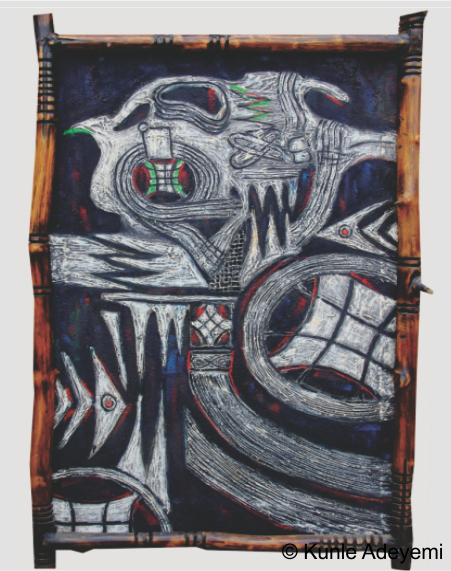
Kunle Adeyemi in this exhibition, 20 years in the Art Jungle…, has demonstrated his mastery of artistic techniques with mature nuances. He is an experienced artist, art administrator and art educator of international standing. He has the experience of over sixty group and seven Solo exhibitions behind him. The exhibition is dedicated to Solomon Irein Ona Wangboje, first Professor of Art Education in Nigeria and who was an artist, art educator, gentleman and inspiration in the best sense of those terms. The late Solomon Irein Ona Wangboje deserves no less.

The exhibition features forty-eight works on display. The works are diverse in themes, materials and techniques. They are all presented in seven different techniques: mixed media, deep etching, oil painting, additive plastograph, plastocast print, and metal foil print. The thematic concern in the Search is very rich. They are broadly classifiable into four categories: issues of environmental concern, socio-religious activities, status and authority, and symbols. Anthropomorphic, zoomorphic, skeumorphic and geometrical forms are ingeniously used in the presentation of the themes.. In spite of this diversity in techniques and subject, the entire corpus is unified by a strong style of bold but dynamic handling of forms, formal balance of forms, colour and texture, very rich surface ornamentation and attention to details. The colours are naturally handled: the brilliant colours are tempered and the dense hues enliven in successive constrasting tones and chroma. The Search constructs and defines artistic and cultural complexity of Nigeria with its paradoxcal buoyant and impoverished natures.

Kunle Adeyemi has seized the opportunity of art being an opportunity to explore, clarify issues and define process for the advancement of the society through this exhibition. In this regard, 20 Years in the Art Jungle, Still Searching constitutes a challenge in the definition and redefinition of concepts in African art. In concept the exhibition is a triple vision. First, it encapsulates the sense of a journey through which one searches the world of physical and transcendental experience. The exhibition allows a search across geographico-cultural and spiritual boundaries culminating into a very rich synthesis of forms and subjects. Second, to search is to seek new experiences and deploy them. The experiences gained in Kunle’s twenty-year search and presented in visual texts redefine Africanness in its characteristically dynamic sense. Third, to search is to seek and verify our process of seeing and appreciating African Art, even scholarly process of clarification and classification.
R. O. Rom Kalilu Professor of Art and Art History
Dean, Faculty of Environmental Sciences, and Chairman, Committee of Deans
Ladoke Akintola University of Technology, Ogbomoso, Nigeria.