My Cart (0)
- April 22, 2020
EXPLORATION OF THE SWEDISH CREATIVE FORGE
By
Kunle Adeyemi
Contact Link: Quintessence Gallery, Falomo Shopping Complex Lagos and Gallery Astley,Uttersberg, Sweden.
Gentlemen and ladies of the press, I greet you all. To say visual arts is the least sponsored and less attractive subsector to sponsor in the arts and culture sector is no more news. One only hopes that with more understanding on the part of the government, coorporate citizens and the public; this hydro headed monster particularly ignorance and lukewarm attitude in not giving visual arts the pride of place in sponsorship will be a thing of the past.
My exploration of the Swedish creative forge (3rd in the series) was facilitated by Chief Mrs Aino Oni Opaku, Chief Executive Officer, Quintessence gallery, Lagos, at the first instant. This current in the series of cultural exchange visits to art house, studios, workshops, schools, galleries, artists, museums, etc was quite exploratory, unique, educative and collaborative.
If the visual art is given the right orientation, support, patronage and funding, the subsector would become a major money-spinner, a mass employment-generating venture, and a cultural value enhancer for the Nigerian economy.
Gentlemen and ladies of the press, it was a pleasant experience for me as programmes were already drawn up before my arrival. Some of which include:
- Residency at the Galleri Astley Studio, Uttersberg – Oct. 16 – 11 Nov. 2010.
- Guest at the Grafik Triennale XIV of the Grafiska Sallskapet – 100 AR Oct. 26, 2010.
- Guest lecturer at Galleri Astley museum – November 1, 2010.
- Printmaking workshop facilitation at Grafikverkstan Godsmagasinet, Uttersberg, Skinnskatteberg – Nov. 4th – 7th, 2010.
- Guest lecturer at Orebro Art College – Nov. 9, 2010.
- Guest lecturer at Vastmanlands Lans Musuem, Karisgatan, Vasteras – Nov. 10, 2010.
- A solo art exhibition of my works shown in and out of the residency programme titled “The Beauty in Freedom” – Oct. 31 – Nov. 27, 2010.
All the programmes were well attended as the organizers have advertised them in their network. The publicity was rich both at the national and local levels. The media (print and electronic) were in attendance (copy attached).

In their remarks (both written and verbal), the organizers expressed their heartfelt appreciation and high ratings scored by the lecture deliveries and would be glad to have the artist, lecturer back in Sweden anytime he wishes. The exhibition was declared open by the Nigerian Charge de affaires in Sweden, Mrs. Naomi Chukwumaeze in the presence of art lovers and patrons which include the former Ambassador of Sweden to Nigeria – His Excellency Lars Owe Persson. The exhibition received much attention and successes. In her address, the Nigerian Charge de affaires, Mrs Naomi Chukwumaeze expressed her happiness and appreciation to the Swedish culture ministry on whose platform the exchange programme was fostered, the Galleri Astley management, the artist; Kunle Adeyemi, the sponsor; Dr. Benoy Berry, and all other collaborators that made the programme a success. To her, it is a plus for the Nigerian nation particularly in the promotion of the rich culture of Nigeria. She was full of praise for the artist, Kunle Adeyemi for portraying Nigeria in a good light at the local, national, academic, practice and even commerce level in Sweden. She berated the attitude of some Nigerians who indulge in committing crime of all sorts in foreign land to take a cue from the shinning example of Kunle Adeyemi. She solicited that his type of opportunity be extended to more Nigerians particularly the budding artists.
In his remarks, Ambassador Lars Owe Persson was full of thanks to Galleri Astley for hosting the 2010 edition of the programme and embracing the culture of continuity. He envisioned that the programme would in future be a visual festival involving more artitsts from different countries of the world. He pledged his full support for the Sweden-Nigeria visual arts cultural exchange project. The management of Galleri Astley on their own part pledged their willingness to continue the programme as long as it is seen to foster unity between Sweden and other nations of the world.
The residency programme was very exploratory and a good exposure to new materials and technology in serigraphy art of printmaking. In total, 45 works were presented at the exhibition which featured different techniques. These includes, block print, serigraphy, mixed media painting, beadworks, ivorex, plastocast, deep etching, plastography, additive plastography, etc. The reception was equally warm. The exhibition will last for 4 weeks.
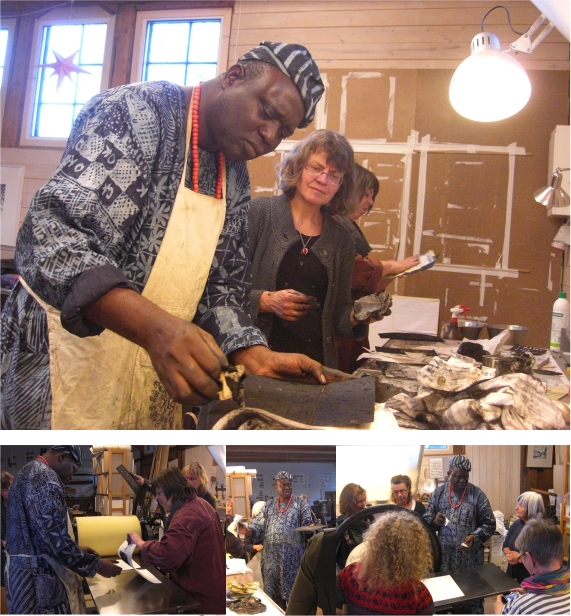
The print workshop facilitated by me at the Grafikverkstan Godsmagasinet studio, Uttersberg was well attended as the facility for the fist time had a 100% full capacity attendance. Participants, mostly women were drawn from the artists, administrative and Non Governmental Organisation (NGO) sectors/community. Additive plastography of the intaglio process was the technique taught at the workshop. All the participants were fully engaged for the 3 day workshop in theories, lectures, demonstration and do it yourself methods of instruction (lecture notes and photogragh attached). The participants at the end were able to create and practicalise what has been passed to them. They equally pledged to continue to practice in their different studios and improve more on what they have learnt.
The paper presentation which was exclusively on the contributions, lives, times and works of 3 contemporary Nigerian artists namely; Susanne Wenger, Bruce Onobrakpeya and Nike Davies Okundaye was well received. The presentations were done in 3 different art centres namely:
- Gallery Astley Musuem
- Orebro Art College and
- Vastmanlands Lans Museum, Karisgatan Vasteras.
These organizations were impressed after each presentation and certificates/letters were given in appreciation (certificates, photos andlecture notes attached).
The result of my visit to cultural institutions, art schools, as well as my direct contact with artists, galleries, and art connoisseurs in Sweden has made me draw up the following observations about the visual art practice and administration in Sweden. These suggestions if critically looked into and applied where necessary will go a long way to give a developmental lift to our visual art practice in Nigeria.
LESSONS
Art practice in Nigeria is not yet a profession by international standards even though long years are spent to train for it. Only a few percentages of those who trained as artists live solely on art. The problem of poor training, lack of confident personnel, mismatch between state policy objectives and its implementation, poor organizational ability among artists and general lack of discipline and respect for one another makes the professional status of art in Nigeria unattainable. The art ecosystem is low in terms of capacity building. The Nigerian artist works alone, is selfish and thinks unprofessional.
Osa D. Egonwa 2007
The quotation above is a true reflection or picture of our visual art practice in Nigeria. It is incidentally a direct opposite of my experiences of the visual art practice in Sweden from my recent tour of art houses, facilitation of art workshops in some schools and holding a major one man art exhibition in one of the galleries located at the country side (Uttersberg) Skinnskatteberg, Sweden.
In the light of the above, I will quickly take you through my observations of the visual arts in Sweden, the progression it has attained and the respect it has earned from both the government and the people.

- The arts moves at the same developmental level with other field of human endeavors i.e. medicine, science, technology; architecture etc.
- Many Art Association’s exist aimed at developing different genres of the visual arts profession e.g. Association of Graphic Designers, Graphic Printmakers Association, Association of Oil Colour Painters, Association of Water Colour Painters etc. These associations are free for all artists to join. One can be a member of one or many of these associations as long as ones financial and professional capacity can take. Each association drives at reaching the newest level of modern art development. They float activities, exhibitions, workshops, seminars, talk shops, awards of scholarships, grants, etc for student artists, budding and professional artists.
- Different art related agencies such as art galleries, print shops, art associations float different visual art programmes aimed at promoting the arts at different times of the year, some of these programmes are exhibitions, art workshops, community art projects, art residences, etc and at different places all over the country.
- Art publications, such as art books, magazines, art guides, culture news aimed at spreading and strengthening the visual art culture is highly encouraged.
- The artists put themselves together in groups of between 2 to 10 or more people to secure grants, aids or scholarships from willing art institutions, donor agencies, banks, multinational companies, etc to work on art related projects which could sometimes be national or community based.
- There exists special preparatory level of education (post secondary schools) solely dedicated to visual arts and environmental studies as foundation for a 5 – year art training at the art academy which is the highest institution for art training in Sweden. In this school, Swedish future artists, industrial designers, technologists, printmakers, visual communicators and production managers are exposed to intermediate arts and science needed for application at the advanced level of their profession.
- The practicing artist/lecturer in Sweden do not just acquire degrees for its sake; because of promotion. They go back to school because of the conviction that they will gain more knowledge especially new areas, technology or related development.
- Planning is a major tool in their art programmes. Art programmes in Sweden are planned for at least 12 calendar months, sometimes 2 to 4 years depending on how broad the project or programme will be.
- Art club membership is part of their national life. Vibrant Art clubs within a community of 100 or more families exists. These art clubs provides platform for art exhibitions, musical concerts, art talks etc. Art purchases are sometimes done through the art clubs. The art clubs float lotteries for members to win some highly publicized artworks by a particular artist. Workers of National, Multinational Companies, Banks, Educational Institutions to mention just a few of not less than 20 in its employment form Art clubs with the aim of being able to buy art for members’ consumption, invest in art, and equally make profits through art by establishing a gallery or art concerns that profits in art at the secondary art market.
- In Sweden, visual art and its allies; such as, film, drama, theatre, dance, literature, etc are taken as religion and the people enjoy them.
- People speculate and invest heavily on arts or artists who are professionally consistent and have focus. Buying art is a form of investment to them. Good art is valued to the extent of equating it with vianble stocks; even sometimes more valuable than stocks.
- Art auction houses are common phenomena in Sweden.
- In Stockholm City (capital of Sweden), about 35% to 40% of the sophisticated shops in good locations sell art or art allied or related products.
- Visual art literacy is very high in Sweden. Text for display of any kind written in Swedish languages, very elaborate and well-illustrated.
- The array of art writers, art makers, art promoters and dealers meet and are in unity, constant touch with each other in the areas of programme planning, critiquing, scholarship and art promotion in cities and villages.
- The appropriate art agencies at the local, state, regional and national levels support the artists and general studios.
- The government creates a conducive environment for the artist, colonies or art villages where artists work together and influence each other positively. In Stockholm, big studios with all necessary facilities are built for the artists.
- There is a very rich, compact and good scholarly standard of text available for the teaching of art theories/history and practice in all the schools, studios, and preparatory art classes.
- Despite the fact that the Swedish education authorities allow art books by foreign authors to come into their system; their indigenous art scholars, historians, critics, art writers have done so much in the area of art book publications. I found out that publishing, printing and education is heavily subsidized in Sweden. Education is free at all levels for the citizens.
- There is a growing concise and conscious historiographical documentation about their arts and culture. Most Newspaper and magazines place prime importance on the culture and arts pages. The electronic media equally give more air time on arts and culture matters. Art pages and airtime generate enough advertisement like other desks for the media. There exists specialized tabloids and magazine for art and culture only.
- There is a strong foundation in art practice, history, criticism and aesthetics for Swedish art producers and writers. Amuniversity solely created for the visual art called the Swedish Art Academy enhances a high level training in art practice and theory. Other universities and colleges equally have standard and flourishing art schools.
- Museums and art centres delivering art services to visitors and indigenes alike are established at locations with a population of between 2000 to 5000 people. These art houses are sometimes funded by the community, donations, subventions grants from institutes, donor agencies and private individuals (art lovers).
- School children, students and retirees are regularly encouraged and taken out on field trips to art houses, galleries, museums, National Art Centres etc to see and know more about the latest happenings in the art of Sweden.
- The Swedish education curriculum builders did not build their art and environmental studies only for aesthetics and entertainment. Instead, they incorporated the appropriate synergy between the academia and industry. Thereby making the visual art studies functional and relevant in all works of life. By so doing, the artist is as important as the medical doctor, lawyer or engineer.
- Art literacy programmes are common knowledge in Sweden. There exist non-governmental organizations (NGO), art clubs, art agencies that organize and hold regular art and environmental training programmes at designated museums, art centres, etc in major towns in Sweden. People are taught how to take care and beautify their environment.
- On a continous basis experienced art critics are featured on television stations, radios and print media to discuss Sweden’s Art Developments, artists, opportunities, grants, aids, scholarships, events, auctions, etc which helps to heighten the art awareness.
- Mentors, versatility, consistency, new experiments and new discoveries in visual art parlance are regularly celebrated.

I hereby, conclude that with the above enumerated synoptic analysis based on my experiences in Sweden we (stakeholder) needs to do more than we are presently doing, if we brace up for the challenge. Our situation in the visual arts will move forward and be at per with other professions in the body polity of the present day Nigeria.