My Cart (0)
- April 23, 2020
SOS 2011 EXHIBITION – Rhythm of Life: A Critique
I did conclude in the foreword cum critic of the 2010 edition of the SOS sponsored art exhibition of paintings, prints, drawings and mixed media works of the trio – Abiodun Okemakinde, Olaolu Smith and Fabiyi Oluwatosin titled ‘A loving home for every child’, ‘One prays these young artists would work harder and give their utmost concentration to the arts.’ In the write-up, I encouraged the staff and management of SOS Children Villages, Nigeria that this is just the beginning of the promotion of these budding artists. I harassed that it is not enough to show them once and stop. In my words, ‘the best they could do to these youngsters to maximize their potentials is continuity in promotion which will ignite them to go back quickly to their studios for more creative excitement.’ These I know the SOS Children’s Village management has taken up as a challenge and draws up an agenda for the coming of this 2011 year group. Two things are particularly encouraging and interesting about this year’s show.
First, the numbers of artists trained from the village have been enlarged to accommodate new entrants. Three more creative hands are added to the existing three bringing the list to six. Also, with the inclusion of these new creative hands, the varieties and coast of the group and their exhibition is automatically enlarged. This addition has created room for drawing works, leather, bead work, plywood cum journey work and crafts. Secondly, the venue of the exhibition understandably has been changed from the trial, makeshift display centre of their Gbagada National Office to a more exhibition friendly, custom made art exhibition hall of the National Gallery of Art, Aina Onabolu studio, Iganmu, Lagos. This is a cherry news to all art stakeholders as these young artists are put this time on a national scape and particularly the vibrant, mega – Lagos audience.
These are new dimensions, excitement and encouragement to the art and craft work of these budding artists. Also, the former trio of Biodun, Laolu and Tosin have improved on their art tremendously. Clearly, this is a show of considerable scope and ambition, and the same can be said of its preparations from both the artists and the promoters. And the same can be said of its catalogue, a crucial supplement to the exhibition itself. Nonetheless, the actual works that make up the ‘2011’ edition of SOS exhibition provide a sense of hands-on invention and adventure that one has seldom encountered recently in a medium sized group shows of a Nigerian Contemporary art. Altogether, the works on display show some stint of self taught
artists working in modern styles. Though, some of these works made me arrive at a vexing point in the areas of its scale, medium, style, finishing and packaging. What provoked my irritation and vexation is the near lack of dynamism and innovation in the subject matter, draughtsmanship, structure and sometimes composition. Though, Biodun’s work can be absolved from this category probably because of his experiences and long years of exposure with some master artists. I am hopeful that in the near future, the art of these budding SOS artists must be cast, superficially in a good language with equally good deployment of idioms, critical of its inflections and a total deflection from its references. However, at their level, the works shown at this exhibition are strong, varied and shrewdly responsive in the ambivalent western/non western synthesis they engage. In some of the works, Biodun and Laolu envinced a vividly detailed sense of fantansy. Works such as happy moment, Gele-o-dun, celebration of life, melody makers by Biodun and Sax-Accords, Dance tune, Aquatic habitat, Sundew, African pride by Laolu demonstrate this. The works in this show by all the six artists are vividly entertaining. The joy in pushing these groups forward rests on the fact that most of them are largely self-taught and graduates of the SOS elementary schools and workshops. In essence, their art are sometimes an auxiliary practice to their present status as students and commercial printers. Exemption is however given to Biodun and Laolu.
Rather than using the brushes of a painter, Abiodun preferred even at the beginning of his career, etchings, woodcults, linocults, ivorex, plastographs, plastocasts, metal foil, etc. The forms that are considered so characteristic of the Onobrakpeya School. However, the six artists’ Christian upbringing combined with their childhood experiences at the SOS Children’s Village, Isolo brought together twin streams of their convictions: African tradition and Christian education.
Abiodun Okemakinde, Olaolu Smith, Oluwatosin Fabiyi, Juwon Jones, Mobolaji Johnson and Oben Sunday grew up at the SOS Children’s Village, Isolo, Lagos. Biodun attended Matori Grammar School, Okota, Isolo, Lagos and later capped it with a National Diploma in Business Administration from the Eruwa Campus of the Polytechnic, Ibadan. He trained briefly in graphic art and printing in Shomolu. Abiodun’s special opportunity came when he was introduced to Dr Bruce Onobrakpeya by the then National Director of the SOS Children’s Village, Nigeria, Mrs Agatha DaSilva. At the Onobrakpeya studio in Mushin, he spent a resourceful 5years training in the art of printmaking. He is now a full time studio artist doing what he knows how to do best at the Kunle Adeyemi Studio in Mushin, Lagos. Olaolu and Biodun’s love for blues and earth colours is significant and worth mentioning. Olaolu based his images on still life objects,
happenings and environmental urges around him. Olaolu, a graphic design specialist from the University of Benin, Nigeria, has experimented severally with water colour, pastel, crayon and other media.
Oluwatosin Fabiyi is a quintessential artist. One cannot ignore her uniqueness when it comes to visual creativity. Her colours are very fluid and airy. Her use of yellows, pale greens and warm reds are exceptional. Her designs are textile in approach. One can perceive the strength of her textile approach to visual art even in her painting titled ‘Walking along the path of life.’ She is quite promising, dynamic and creatively gifted. She matches the terrain of visual art practice like a would be colossus even though her training in school was business administration. If she concentrates and develop her artistic talent and go for more training in the vocation, Oluwatosin will definitely be a master artist in the nearest future. Oben Sunday is an artist to watch particularly his love for woodwork and crafts. Some of his work reflect single image compositional structure. He has passion for painting, carving, water colour, crayon and other media. Also, Mobolaji Johnson’s flair for leather work and beadwork is worth commending. A fashion designer by training, his beadworks in some of the applied art he engages in distinguishes him in the group. Juwon Jones, the last of the six is in a world of his own. A realist and semi-abstract artist who uses elongationism as a style. His mediums are most times charcoal and graphite on paper. A deeper interest in this art may distinguish him in future.
Conclusively, the effort of the SOS management in packaging these young artists is commendable. The first in the series gives way to this second show which is another way of saying that no exhibition can be all things, and this one, in pursuing its specific objective, has laid the groundwork for more investigative work in the future. For this – and for promoting these budding Nigerian artists, we now know – SOS Children Village, Nigeria’s management can only have our admiration and our thanks for a job well done the second time.
Happy viewing.
Kunle Adeyemi, 2011
Lecturer and Research Student,
Delta State University,Abraka, Nigeria
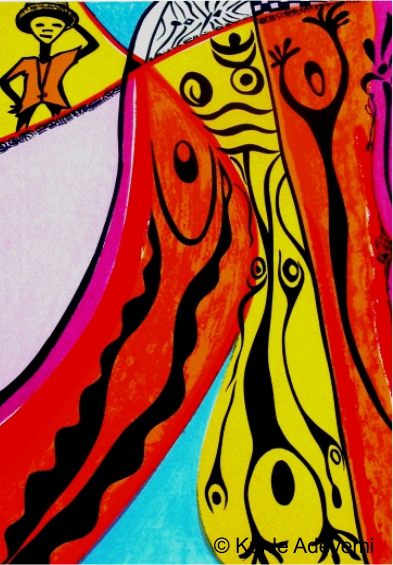
Rhythm of Life is an exhibition of drawings, paintings, beadworks, printmaking and mixed media works, organized by the SOS Children Villages, Nigeria.
Venue: National Gallery of Art, Iganmu, Lagos. Date: 25th October, 2011.