My Cart (0)
- April 23, 2020
SIGN, SYMBOLS, FORM AND MOTIFS: A GLIMPSE INTO NIGERIA’S DEMOCRATIC STABILITY
INTRODUCTION
Signs, symbols, forms, motifs, and patterns to Africans are so closely interwoven in the fabric of our long past. They came to us through the ages in the areas of communication, documentation, information, identification, socialization, entertainment, etc. They are so knit and interwoven that they become difficult to define with clarity the differences in meaning among them. Yoruba of the southwest Nigeria would say: Atewo la ba’ la aa meni to koo, meaning we just woke up or met the scarifications or lines on our palms; we do not know who wrote them.
Louise and Raymon Ballinger (1972) classify a sign as a distinguishing mark or characteristic. Signs (letters) and forms are used generally to communicate ideas, to warn or to explain an area’s contents, and also to mark a token of something intangible. Whereas symbols and patterns can be classified as a form that stands for something by relationship, suggestion, interpretation, resemblance or association, it could equally be a form that reveals quantity, special elements or varieties. Much of man’s written means of communication today can be traced to symbols of the past. These symbols are derived from simple environmental elements or shapes such as man, animal, tree, abode, sun, rain, lightening – which put or arranged in a certain order of communicating an idea or message.
A classical example is the Chinese writing with its infinite variety of characters. This according to Louise and Raymon (1972) is based on traditional brush drawings of symbols representing objects of everyday life. The simplicity and directness of older African signs, symbols, motifs and patterns have given a lot of inspiration to modern contemporary Nigerian artists, individually and in groups. A good example is the Uli group of artists from south east, Ona from south west, and Arewa from Northern Nigeria. Each of these groups has its distinct philosophy and ideology. These groups and some artists including my humble self are now exploring and researching into symbols, signs, motifs and forms in ways that are
neat, excellent and timeless.
APPLICATION
My works respond to the dynamics of continuity and change. In my neighborhoods, and my constituency, Yoruba, Nigeria and Africa at large.
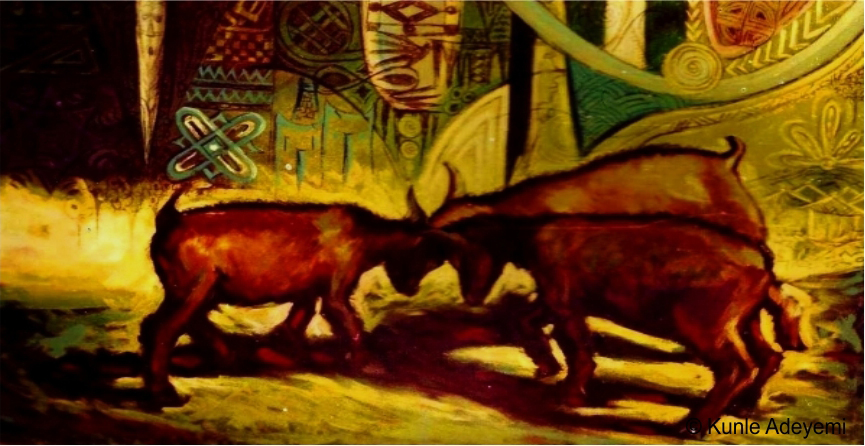
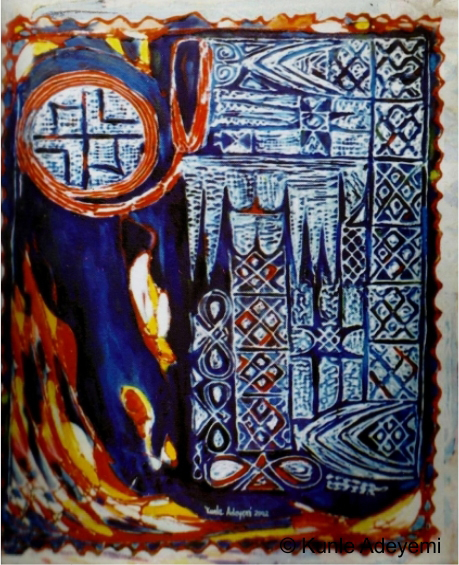
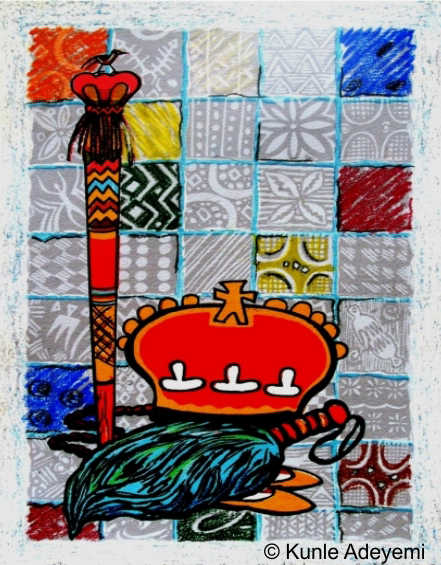
I draw inspiration from Yoruba traditional artistic forms, and I study and adapt forms, decorative motifs, traditional patterns, and signs of the Yoruba. These forms are mainly from woodcarving such as house posts or pillar posts free-standing sculptures in some Yoruba homes and public places, Ifa divination trays, carved masks, carved doors. Other inspiring sources are utilitarian and ornamental crafts, such as pottery, tie-dye / batik (Adire Eleko), leatherwork, calabash and gourd-carvings, weaving, basketry, mat-making, body adornment and patterns and symbols drawn, painted or moulded on shrines, walls and some public places such as the Oba, chiefs and traditional priests’ palaces.

My focus in researching into these areas of art is not only to be a visual authority on Yoruba, symbols, signs and motifs, but to educate, visually, those who come in contact with my works, and make them enjoy the aesthetics, visual imagery, significance, philosophies, and the pictorial language
THE GLIMPSE
This exhibition seeks to concretize my experiment on signs, motifs, symbols and forms with a particular highlight on its relevance to the African race. The black race is beset by much of the challenges that define life. It is within the democratic context that such problems would be overcome. I use these symbols, motifs, signs and forms first as a metaphor as well as a direct vehicle of communication to bring into sharp focus discussions to these problems and sometimes solution to them. Overtime, the good, the desirable, the dreamt of, will evolve, following years of countless flaws – what is imperative is that we stay the course in the face of daunting difficulties, and ultimately the promised land will be at hand. The theme of this exhibition is used as a codification of what humans in our own part of the world stand to achieve using our limited progress as a basis. After all, we arrive at the known from the unknown.
This show is to further give meaning and translation to these signs and symbols, etc., I believe that after calm and measured reflection of them as they are stylistically employed with religious respect for the principles of aesthetics, a new way of viewing and acting them will emerge. Also, this show is to enhance greater understanding of the spiritual and physical import of the signs, symbols, motifs, etc. I appreciate the fact that many writers have documented so many on them. My concern at this stage is to create some form of visual perspective of them.
CONSISTENCY
The urge to stage another solo show after a gap of twelve calendar months is deliberate. With a landmark achievement of my last exhibition, I believe that there is an urgent need to keep students, collectors, and critics abreast of the art as an invaluable constituent of life. This is not a forum to trumpet what the art has on offer, but it is necessary on the part of the artist to remind the audience out there that he is still working. Some may observe a period of creative hibernation for whatever reason. I strongly believe that consistency will put the art project in good stead as it battles to maintain relevance among a thinning rank of connoisseur in our society.
Also, I believe this is a time all artists donned their creative caps and worked to actualize the artistic goals of breaking novel frontiers. The pecuniary factors may prove somewhat discouraging with its attendant capability to weigh one down, but the hunger to speak new language, drive home some points and to proffer germane answers to pertinent questions in the art and human project will always triumph. In summary, we must make history.
I thank God, the host, Quintessence, has provided yet another platform to display these artworks, or better put, air my view.
As a parting shot, let me say, without fear of being accused of being boastful, that Nigeria’s artistic terrain, not least our Art Schools, can produce some of the best artists in the world. Just as the French system gave rise to impressionism which in turn bore the Picassos, the Sureats, the Manets, and the Guanfins. Today, a lot is read about what they came, saw and conjured.
Kunle Adeyemi, 2005
Exhibiting artist
References
L.B and R.A Ballinger, (1972) Sign, Symbol & Form, Van Nostrand Reinhold company (Litton Educational Publishing, inc.) New York, NY 10001
Filani K, (2005) Patterns of Culture in Contemporary Yoruba Art, Symphony Books, Nigeria.
Adeyemi K, (2004) 20 years in the art jungle, still searching, catalogue of an art exhibition held at the National Museum, Onikan: Wangboje’s Art Gallery, Osborne Road, Ikoyi, Lagos
Amodu R, (2003) The Symbolic Synthesis of Kunle Adeyemi, New Wine, Exhibition Brochure, Lagos A.V. I. Services Limited.
Akinwumi T.M (2002) Art and Political Leadership: The Example of the Alake, Journal of Cultural Studies, The Dialetics of Culture and Development, African Cultural Initiatives, Olabisi Onabanjo University, Ago Iwoye, Ogun State, Nigeria.