My Cart (0)

- April 23, 2020
THE CREATIVE FUSION OF KUNLE ADEYEMI’S PAINTINGS AND PRINTS: A DISSERTATION OF A PURE ARTIST
Introduction
For many years, he was a painter, then came the adorable multi-facet volt charged creative current of the printmaking medium, Kunle Adeyemi surrendered to this new artistic challenge and the union is still waxing strong till date. He fell for pure printmaking inducement of having many original prints in many copies of one particular work form one matrix. Or, a particular work could be reproduced into the creation of many other original works of art with the same theme and composition. Though, the reproductive process will follow the employment of the different types of printmaking techniques and classifications in existence. Some of these printmaking classifications are lino print, deep etching, metal foil, epoxy resin, ivorex, plastocast, additive plastograph, serigraphy, woodcut and few others.
Adeyemi’s joy keeps on increasing in multiple dimensions as printmaking discoveries upon discoveries keep dropping at his feet in a fair tryst with serendipity. The painter in him occasionally puck their heads and hearts into his prints, he would technically classify such works as mixed-media. These mixed media art pieces are desirable combinations of printmaking technique and painting skill in a creative fusion of pure artistic ingenuity. It has taken Kunle Adeyemi many years of creative research and intellectual as well as practical indulgence, stoicness and steadfastness of purpose before arriving at this point of accomplishment reserved strictly for master artists.
Background Review
With an HND (Higher National Diploma) in Painting (Yaba Tech) and an MFA (Master of Fine Arts) in Printmaking (UniBen), Kunle Adeyemi definitely has the academic qualification to bask in as he deemed fit. Working as a lecturer in his alma-mater: Yaba College of Technology, Lagos, also helped his course and professional growth. So, he is always at work, whether as a Fine Art lecturer or as an artist working in his studio/office or even at home, he is always at work – 24/7.
Many years ago, he thought he was through with painting without realizing he has all this while been painting. Most of his so called prints are revisited themes that he has painted at one time or the other. Majority of these subjects are reproduced from photographs or sketches of long lost artworks to communion of art collectors. Collectors who are forever lurking in the shadow, dangerously armed with desirable bundles of cash to pounce on and spirit away artistic masterpieces with reins and rains of cash. The distasteful dance and romance with poverty at the beginning of the professional take off of many artists are better forgotten stories which many masters would prefer kept out of the public domain. Many undocumented great works were lost during these dry dangerous years of war – with rugged poverty.
Thank God for change, the ever constant denouement in the universe, who drove away the terrible times and ushered in the good times. Since with maturity and dedication to the art comes mastery and success it well managed, the success may last forever but anything otherwise will be foolhardy and retrogressive. “God help those who help themselves.” It is safer and better to plan and execute your plans as an artist with ruthless creative ease, just like Adeyemi who has been marching on for many years. He has really helped himself with God on his side, he has nothing to fear.
Present Development
From painting to printmaking, and from printmaking back to painting, it is all one and the same to Kunle Adeyemi, he reminisced and borrowed from relics of his wonder years as a boy in his home town, Ondo. Through the years, he was able to create an amalgamated peculiar works of art which were hitherto referred to as mixed media. These so called mixed media are now being perfected as a unique fusion of painting and printmaking into a wholesome artpiece which could have a matrix or not. It will also have the printmaking methodology as well as the philosophical and essential painting characteristics and finesse.
The aforementioned is the present development in Kunle Adeyemi’s creative endeavours, a culmination of over two decades of art practice and research. It will equally have an academically documented backing in his on going Ph.D dissertation. Many years of merging paintings and printmaking to create one art form will now result in a well researched symbolic synthesis of the works of Kunle Adeyemi by himself in his position as a Ph.D student of Fine Arts.
Right from 2008 till date, Adeyemi is now an annual pilgrim to Sweden. He travels as an instructor for printmaking workshop, and to exhibit his works. His exhibits this year will include some of his recent works on female nude figures series. These nude series are creative fusions of fine art (painting) and applied art (printmaking) into authentic works of art from the mastery of Kunle Adeyemi. His Ph.D thesis will take care of any other needed intellectual backing required by art critics, historians and art scholars as well as other members of the art community around the world.
The mature and titillative as well as enticing female nude figures have always been a veritable creative challenge to artists of different ages and millennia. I believe, there is an intrinsic atavistic allure at play here and always. It is not just about raw sex, but, about God’s creative abundant endowment as portrayed in the succulent curvatures of the daughters of “Eve”.
From Egytians art (2000 B.C.) to Greek art, Roman art to Byzantine art, Renaissance to Baroque, Rococo, Impressionism, Expressionism, Cubism and other art forms in modern and post-modern art as well as African art till date; the female nude figure always pop up every now and then. These nudes are not usually viewed as sex figures but in most cases as symbols of fertility or as deities of fecundity. One of the earliest known female nude sculpture in the round; “Venus of Willendorf”, 15,000-10,000 B.C. was executed as a symbol of fertility with an aura of fecundity. The seated goddess, “Catal Huyuk”, C.5900B.C. was also a nude terracotta female figure that symbolized fertility and fecundity. Apart from the artistic fact that the adult female form is more creatively challenging to most male artist. The conscious and unconscious creative aspects are really inexhaustible. You must have heard the maxim before, maybe you dismissed it, it goes thus; “you never know with women”.
It is on this premise of trying to know the woman that has gotten Kunle Adeyemi entangled in mind bending creative voyage because the challenge posed by female nudes are mind bending. Adeyemi’s research laden works of art are mow centered on female nude form series. He is exposed to both European arts and African arts as well as arts from other parts of the world.
Kunle Adeyemi must have come in contact with pictures of the works of European artist from the 13th century works of renaissance artist to the modern and post-modern artist of the 18th, 19th and 20th century. Some of the artists being referred to are Titian (1477 – 1576), Peter Paul Rubens (1577 – 1640), Eugene Delacroix (1798 – 1863), Edgar Degas (1834 – 1917), Pierre Auguste Renoir (1841 – 1919), Edvard Munch (1863 – 1944) and Pablo Picasso (1881 – 1973) to mention a few of the historically recorded painters who employed female nude figures in their works at one period or the other. Even in the new millennium, conceptual art and installation art have made use of life human nudes as part of their composition. The British Nigerian artist; Yinka Shonibare, recently posed nude with other male and female nude models in one of his conceptual art presentation in England.
At this point, let us explain and separate the difference between a nude figure from a naked body. A nude figure in art is seen as an elevated creative expression and presentation with sincerity of purpose, moral as well as spiritual growth and goals in man’s exposure of themselves without any form of covering on their body. Nakedness on the other hand is perceived as the raw animalistic state of clothenessness with vulgar and immoral ideas flying freely in the already corrupted and seduced air.

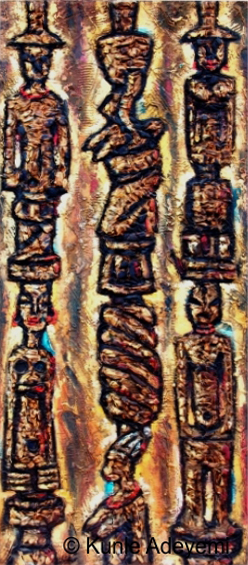
Adeyemi has equally studied the nude carvings in traditional Yoruba wood sculpture, some of them date back to the 17th, 18th and 19th century, especially the “Ere Ibeji (Twin Figures)” series. He recreates one of this “Ere Ibeji (Twin Figures)” in different medium such as mixed media, ivorex, deep etching and so on. The presence of female nude form in the wood sculptures of the neo-traditional sculptor, Lamidi Fakeye (1925 – 2009) is not news to Kunle Adeyemi. Neither is the celebration of female nude forms as creative masterpieces, deities of fecundity and fertility or as goddess of the sea (Yemoja) in the works of the Surrealist master – Abayomi Barber new to Adeyemi.
He is well acquainted with the Onaism inspired sublime sets of female nude series of paintings of one of the founders of Onaism; Tola Wewe, who happens to come from the same state with Kunle Adeyemi, Ondo State, Nigeria. Onaism is an art movement which encompasses everything that is creatively and essentially Yoruba in tradition. It (Onaism) could also blend in a unique artistic fusion with other art forms of Nigerian and African origin as well as patterns from other parts of the world to create a wonderful “Ona” work of art. Ona art really encourages artistic marriage of the peculiar traditional patterns and forms of the Yoruba with or without non-Yoruba symbols and motifs in a contemporaneous milieu. Adeyemi’s works are perfectly in consonant with the philosophy and practical submission of Onaism. His culturally and traditionally inspired works of art, which were forged with a contemporary essence in a sublime manner will ordinarily be classified as works of an Onaist. We shall conclude on the classification of his art works in the nearest future.
Conclusion
His works in recent years, especially right after his masters’ degree programme in 1998, till date always come with pure Yoruba/African essence gazing at us with a quintessential creative salvo. The artpieces are usually enhanced with innovative traditional Yoruba/African forms and patterns. These mostly distinguished Yoruba symbols and motifs are used by Kunle Adeyemi in his works to document, educate and promote his rich cultural heritage. Man’s promotion of his cultural heritage is his socio-cultural responsibility and civic duty to himself, creed and country. Any one who is not proud of his or her culture, and also ready to defend such a wonderful, peace loving and civilized culture or a race, such as the Yoruba, is a disgrace to humanity. So, no more works without any cultural symbolism and distinction from Kunle Adeyemi’s studio. The cultural coloration in the works are dignified signature of class and authenticity of a nature artist and master of his trade.
Apart form his new works; the mixed media, which are mostly female nude series that dwells on the belaboured topic of fertility and fecundity, they also treat the beautiful curvatures of African ladies well adorned with real beads and moulded ones to create high classed set of works. There will still be the “Ere Ibeji (Twin Figures)”, “House Post Series” and many other works in the show.
I hope and pray, we will not have the archaic “old school” dull brown and gray colours that are common placed with printmaking of yore still enjoying too much space in one or two works too many. Just give us works like “The African is Beautiful”, “African Masks”, “African Hair Adornment” and other works with lots of brightness and fire, sunshine and power, peace and progress, class and prestige. With such aforementioned works, we can all go back home after the show, overwhelmed with the arrays of masterpieces on display. Thank you.
Rasheed Amodu (M.A.)
Artist, Art Historian/Critic
Lagos, Nigeria.
October, 2010.
References
Amodu Rasheed (2003), “The Symbolic Synthesis of Kunle Adeyemi”, New Wine,Exhibition Catalogue of the Works of Kunle Adeyemi, SheratonHotels and Towers, Abuja, Nigeria. Pp. 1-23.
Amodu Rasheed (2009), “The Creative Serendipitous Treasures of Kunle Adeyemi’s Prints”, Kunle Adeyemi: Tradition Och Samticd, Exhibition Catalogue of the Works of Kunle Adeyemi, Galleri Astley/Burkina Faso Design, Sweden. Pp. 1-24.
Cottington David (1998), Movements in Modern Art, Tate Gallery Publishing Limited, London.
Filani Kunle (1996), “Images of Women in Tola Wewe’s Paintings”, Rhythms of Ona; Art from my Soul, Exhibition Catalogue of the Works of TolaWewe, Russian Cultural centre, Lagos, Nigeria. Pp. 1-21.
Filani Kunle (2005), “Four Artists From Formal Schools”, in Patterns of Culture in Contemporary Yoruba Art, Symphony Print Shop, Nigeria.Pp. 31-64.
Gardener Helen, Horst de la Croix and Tansey Richard G. (1975), Art Through the Ages, Harcourt Brace Jovanovich, Inc., New York.
John Pemberton 3rd (1982), “Descriptive Catalogues: Preface”, in Yoruba Sculpture of West Africa, Bryce Holcombe (ed.) New York: Publishedby Alfred A. Knopf, Inc. Pp. 1-212.
Harris Nathaniel (1979), A Treasure of Impressionism, Published by Optimum Books, London.
Marshall Cavendish Weekly Collection (1991), “Munch”, The Great Artists-
Their Lives, Works and Inspirations: 74, Published by Marshall Cavendish Partworks Ltd, London.
Murray Peter and Linda (1968), A Dictionary of Art and Artists, Penguin Books Ltd, Great Britain.
Payne Laura (2000), Essential Picasso, Parragon Book, United Kingdom.
Vaizey Marina (1983), 100 Masterpieces of Art, Published by Peerage Books, London.
A Collection of Famous Old Paintings, Pp. 1-235