My Cart (0)
- April 23, 2020
Advocacy for New or Alternative Directions in Studio Art Making in Nigeria: Hands-on Factors
By Kunle Adeyemi
Abstract
An overview of visual arts particularly painting and its practice since 1900-2000 has been quite dynamic and evolutionary in the trends that pervaded the art scene in Nigeria. However, there has been a shocking revelation from available literature, knowledge and practice of painting that after one full decade into the new millennium (2000-2010), there seems a downward slide in artistry as some of the new art graduates and other budding artists seem to have lost the professional ethos, innovation, intellectual and technical depth of the extant art tradition and by extension do not bother to explore or experiment. This study opines that there is the need for a revamping of practice through creative techniques, hands-on skills and ways of going about studio practice in painting. The objective of this study is to facilitate a rebirth of professionalism in studio practice through a practitioner based problem solving advocacies which include: openness to new experience, uniqueness and individuality, wonder and curiosity, professional risk taking, the use of indigenous symbols and decorative forms, taking advantage of accidental events, integration of synthesis, waste to wealth principles, persistency and so on. Many of the suggestions advocated in this study have innate potential to advance the limit of the present boundary of easel painting practice and reverse the decaying trend in Nigeria‟s present easel painting tradition.
Advocacy for New or Alternative Directions in Studio Art Making in Nigeria: Hands on Factors
Introduction
Art making, that is studio art practice in Nigeria from 1900 to about 2000, has been quite dynamic and evolutionary. Virtually all the areas of visual art practice which include painting, sculpture, graphic, ceramics, textiles, craft, printmaking witnessed tremendous growth both in human and capital development. These visual art genres were adequately exposed to developmental competitions by practitioners through global sophistication, education and technology. For the purpose of this study, our emphasy will be focused on easel painting. Modern Nigeria painting, however, dates back to the first decade of the 20th century. Chief Aina Onabolu (1882-1963) had begun producing art in the modern before 1920 when he trained abroad. He introduced art formally into some schools in Lagos. He was later joined in 1927 by Kenneth C. Murray (1902-1972) a British national. Fosu in Emeni (2005) has this to say; Onabolu‟s works unlike Murray were characterized by standardized European academic formalism, balanced proportion and destructively accurate in anatomical realism. The portrait of Mrs. Spencer Savage(1906) (Plate 1) is a good example of Onabolu‟s style. Akinola Lasekan (1916-1972), a contemporary of Onabolu was also strongly influenced by western expression.
Kenneth Murray’s appearance on the Nigerian art scene added to the creative norms of Western academism but sought to preserve Nigerian cultures and idioms in the works of his student through his teachings. During his classroom career, Murray was able to establish what Egonwa (1993:6) refers to as “preserve our culture” philosophy. Murray believed strongly that it was through the study of indigenous crafts and traditional arts that truly contemporary Nigerian art would evolve. One of the successes of Kenneth Murray‟s teaching was Ben Enwonwu (1921-1994) who was classified by Fosu as “Second Generation Pioneers 1950s -1960s”. Enwonwu as a modem artist employed the traditional symbols and forms as design for a new form of expression that embraced nationalist concept. His subjects in painting and sculpture transcend his Igbo ethnicity. Egonwa (1993), describes Enwonwu’s as a blend of the idioms of a conceptual art with that of a perceptual one (western formalism). Some of Enwonwu’s paintings in this form are; Agbogho Mmuo (1978),
African Dances (1949), Benin to Onisha-Ado (1980), Negritude (1979), Obitun (1983) (Plate 2), among others. Contemporaries of Ben Enwonwu who made their impacts felt in the art practice and teachings are C.C. Ibeto (1915-1996), A. J. Udo Ema (1909-1996) and J.O. Ugoji (1917-1984).
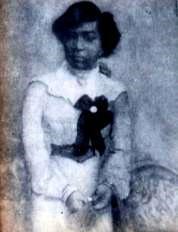
Plate 1. Aina Onabolu, (Dr) Mrs Spencer Savage, Water Colour, 1906
Courtesy: Everyman‟s Guide to Nigerian Art
The late fifties (50s) which is the fifth decade in the 20th century witnessed another generation of Nigerian artists who became active at the dawn of Nigeria’s political independence. These groups of artists are conscious of the nationalist struggles, played their part and eventually paved way for the “zarianist.” These artists according to Emeni(2005) were independent and formally trained and can rightly be considered as Nigeria’s “Vanguard” artists. This group includes artists like Erhabor Emokpae (1934-1984) Okpu Eze (1934-1995), Clara Ugbodaga-Ngu (1925-1988), Isiaka Osunde (1936-2010), Ben Osawe (1931-2009) and a few others. What developed as an ideology was made possible by historic encounters; with the outside world and the historic period of pre-independence struggles with its inherent political ferment. Struggle for self rule injected a new sense of social life, art inclusive. He states further that the pebbles that this group threw into the stream of Nigerian art created resounding ripples that may have activated the Zaria ideologies of the fifth decade. Most of them started with naturalism and took to abstractions towards the end of their career.
The third visible era in Nigerian arts was in the early 1960s. A group of visual art students at the Nigerian College of Arts, Science and Technology, Zaria who emerged on the Nigerian arts scene in the sixth decade of the 20th century, raised on Nigerian soil came together under the aegis of Zaria Art Society. They became popular because of the zeal and articulation of the theory of natural synthesis championed by Uche Okeke; (b. 1933). Natural Synthesis according to Okeke (1998) is the combination of old and new ideas, old and new techniques, and individual ideas. Uche Okeke (b. 1933), Yusuf Grillo (b. 1934), Demas Nwoko (b. 1935), Bruce Onobrakpeya (b. 1932), became the cornerstone in a quartet of creative expression propagating new visual language and ideologies of representation in contemporary Nigerian painting.
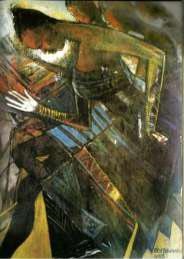
Courtesy: Ben Enwonwu Foundation
Others in the group are: Ekeada F.N. (b. 1936), Okechukwu Odita (b. 1935), Ogbonnaya Nwagbara (1934-1984), Osaeloke Osadebe (b. 1935), Simon Okeke (1937-1969) and William Olaosebikan (1936-1996). This group was later to be nicknamed “Zaria Rebels” due to their radical approach to change of the academic art tradition, which they were taught by their foreign teachers in Zaria. These sets of early Zaria graduates who formed the nucleus of the Society of Nigerian Artists (SNA); with others dispersed into different art areas of Nigeria’s economy particularly teaching, which helped in no small measure in producing art teachers, painters, sculptors, ceramists, textile designers, graphic designers, advertisers and all sorts of professionals in the arts and allied trades. They were able to have converts (Nigerians and foreigners) who appreciate art. The period 1970 -1980 falls into the bracket of curricular innovation in Nigeria visual art education . Some ideological schools emerged on the scene. These are the Oshogbo, Zaria and the Nsukka Schools. They had their peculiar and distinctive characters which mark them out.
The seventh decade of the 20th century Nigerian painters saw the efforts of their predecessors became professionally charged and worked hard to build a firm and better structure on the foundation laid by the “Zarianist’. Some of them after a brief work experience went back to school locally or internationally to seek for more knowledge thereby acquiring higher degrees in professional relevant areas such as; Master of Fine Art Degree (MFA), Master of Art Degree (MA), Doctor of Philosophy Degree (PhD) in Art History, Art Education. A few who did not go for higher education were visible and engaged in consistent studio practice.
The seeds of the different ideological schools have started producing fruits during the 70’s. The Oshogbo school created in the 1960’s by the German linguist, Ulli Beier (1921-2011) assisted by Suzanne Wenger (1917-2010) and Georgina Beier (b. 1925) has produced emerging artists such as Twin Seven (1941-2011), Jimoh Buraimoh (b. 1943), Rufus Ogundele (1945-1992), Murai Oyelami (b. l945), Nike Davis Okundaye (b.1951), to mention just a few. On the other hand, Nsukka school led by Uche Okeke was in meeting of creatively curious minds, which gave birth to the Ulli experiment. They towed the line of Natural synthesis. Obiora Udechukwu stands out as a disciple who mentors others like Tayo Adenaike, Osa Egonwa, Some members of the AKA group of artists. Other artists of the 1970 era who made their impact felt in studio practice are; Dele Jegede, Kolade Oshinowo, Joshua Akande, Sina Yusuf, David Dale, Gani Odutokun, Clary Nelson Cole, Bons Nwabianu, Ray Obeta, Uzo Ndubuisi, Chuks Anyanwu.
Immediately after this group are the eighth and ninth decades of the 20th century Nigerian painters who occupy the 1980’s and 1990’s. This period also experienced an impressive tradition of experimentation in painting, particularly exploration of different materials aside from the conventional oil colour on board or canvas. Materials such as water colour, pastel (chalk and oil), charcoal, acrylic, graphite, conte, beads, industrial paints (emulsion and gloss), rags, jute, waste industrial or home materials were freely and boldly used by painters of this era to create a dynamic impression of a higher height and coming of age (postmodernism) in Nigerian art practice. The tradition of linking poetry with art which started from the Nsukka art school spread among some visual artists of this period. There was the increasing number of those with Master of Fine Art (MFA) and Doctorate degrees in some areas of Visual Arts. This pedagogical effort in artist’s intellectualism helped in no small measure to improve the visual art practice particularly painting. The era witnessed a more pragmatic approach to critical art writings in journals, national newspapers, magazines and book publications. The art of Painting became popular and acquired a degree of intellectual aura that naturally coalesced with the artistic spirit of the period.
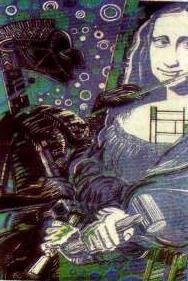
Courtesy: The Nigerian Artist of the Millennium by D.O. Babalola
The painters of this era who are not in the advertising or manufacturing industries pay serious attention to art professionalism, particularly the studio. This was why the period was rewarded with more local and international solo, joint and group exhibitions of those painters who were very sincere and devoted in their creations. By the end of the eighties to mid-nineties, it was very apparent that painting has forced itself into Nigeria’s socio-cultural, socio-economic and socio-political experiences. More painters emerged with unstoppable increase. Many visual artists who trained in the other genre, textiles, graphics, sculptures, ceramics etc. became painters overnight. The growth and development at this period affected various art enterprises such as: galleries, museums, art material shops, art frame shops, etc, The big cities of Lagos, Port Harcourt, Abuja, had their fair share of the development Another interesting innovative development of this period was the adoption of saloon exhibition system. More vistas of opportunities were opened to the artists and the consumers of their products in an almost informal way.
The art of this era witnessed a fast supersonic growth in modern tendencies. The emergence of some exhibiting art groups who are mostly painters also beautified the professional image of the eighties and nineties. Some of these were the AKA circle of exhibiting artists (1986), Ona (1989), Omenka and the Echoes(1989) and the Nogh- Nogh group(1990). More expositions for the Nigerian art equally came from both Europe and America. This age of artistic professionalism brought about by the very appreciable societal understanding and acceptance of art and artists. Some of the painters of this decade are: Nsikak Essien, Osa Egonwa, Bona Ezendu, Tayo Adenaike, Kunle Filani, Tayo Quaye, Jerry Buhari, Osi Audu, Abiodun Olaku, Onyema Emeni, Mike Omoighe, Tola Wewe, Sam Ovraiti, Duke Asidere, Ben Osaghae, Ndidi Dike, Joe Musa, Olu Oguibe, Olu Ajayi, Pita Ohiwere, Kunle Adeyemi, Abraham Ilyovbisere, Mallam Sanni Muaza, Oguigo Edosa, Kefas Danjuma, Lara Ige-Jacks, Tunde Olanipekun, Sola Ogunfuwa, Keinebi Osayande, Rom Isichie, Samuel Ebohon, Ibe Ananaba to mention just a few.
Problems of Slow Growth
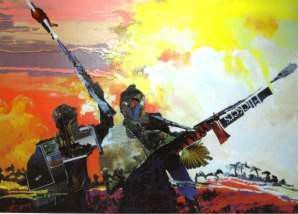
However, beginning from the first quarter of the 21st century (2001 to date) there has been a shocking revelation of painting becoming a repetition of old images, subject matters from exhibition catalogues, reproduced prints, magazines, newspapers, photographs etc. Easel painting in Nigeria‟s art tradition experienced a slow growth. Some of the practising Nigerian artists that graduated from schools of art in the late 1990‟s and the beginning of the new millennium, with all the exposures influenced by information age on art practice; which they sourced from around the world ironically, produced works that are shallow in thematic and contextual meaning, technical quality, intellectual depth with little or no experimental challenges. These creative limitations have been so prevalent in the painting genre. This has led virtually to no relationship between ideas, techniques and materials which in turn have created virtual imitation, copying and repetition of works (Plate 4 & 5). Easel painting has almost become totally commercialized. Intellectual slackness and laziness in theory and practice is more evident as the present day budding painters could not engage in vibrant discourse fused in enlightening theoretical perspective capable of adding growth and development to their professional practice.
This, according to Egonwa (2007);
…is because many artists are comfortably perceived as persons in the restricted domain of skills and talents. This is an unfortunate self-concept that many artists have accepted with an implicit notion that studio activity lacks intellectuality because it is a doing thing, which does not follow the scientific method. This is erroneous because it puts the products of these budding artists in the craft domain.
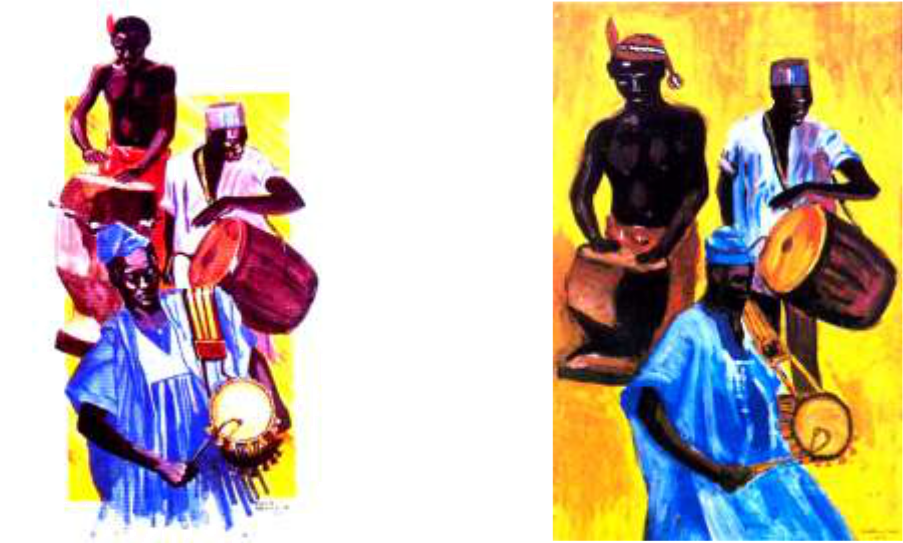
Courtesy: National Gallery of Art
Plate 5, John Jeroghene Gospel, Effective communication, water colour, 55X77cm, 2009,
Courtesy: National Gallery of Art ,
2nd National Visual Art Competition 2009 catalogue
Plate 5; an example of a copied effort by a budding Nigerian artist; the painting by John Jeroghene Gospel, a 21st century Nigerian painter, titled Effective Communication is suspected to have been copied from a 1983 painting by Tunde Ogunlaye titled Music Makers. (Plate 4)
Many painting exhibitions now witnessed almost a repeat pattern of what has been shown at previous exhibitions in term of style, techniques, materials and even subject matter. Subjects which are already thematically boring such as landscapes, festivals, Eyo Masquerade, Durbar, Fura de nunu, horsemen, market scenes, cattle rearers, beggars, Atilogwu dancers, etc. are recurring decimals in our exhibitions.
Objectives
The limitations observed shows that there is need for a revamping of practice via creative techniques, education (formal and informal), advocacy and hands-on-skills on ways of going about studio practice in painting. The objective of this study is to facilitate a rebirth of professionalism in studio easel painting practice through a practitioner based experiential advocacy for alternative or new directions in studio art making in Nigeria. Also, to inspire younger and upwardly mobile practising Nigerian
artists who come in contact with this study. This will introduce a radical, positive transformation and dynamism into the practice of easel painting and may help to stimulate practitioners of other genres of art (textiles, sculptures, graphics, printmaking, ceramics, etc.) in creating a form of influence in the art practice, particularly in forms and material development, exploration, visual idiom and technique. Furthermore, to give an enterprise of originality, authenticity, individual identity and authorship to the budding Nigerian artists and provoke them to create a new or alternative experiment in easel painting for interdisciplinary dialogue and creation, and also act as a means where creative strategies will provoke new ways of thinking.
Advocacy
In the light of the foregoing, this study advocates a rediscovery of the creative attitudes in the future budding Nigerian artists who would want to be successful professionally. These include:
- Ability to be open to new experience: Visual artists particularly paintersmust be as open as possible to new experience, experiments and possibilities. While being open painters must be bold, different and defiant. An example is a mixed media painting made with bottletops and other materials by Rom Isichei (Plate 6)
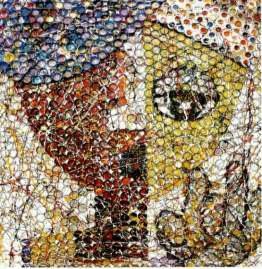
Plate 6, Rom Isichei, Poli-trik-cian, mixed media with bottletops, 86 X 102cm, 2009 Photo: Rom Isichei
- Uniqueness and individuality: Works must seek and exhibit uniqueness andindividuality that is soaked and flavoured in indigenous root. Exploration of form, media, techniques, styles etc to create individuality in this multidimensional age of human advancement in visual arts must be pursued. Despite the fact that Uche Okeke, Chike Aniakor, Obiora Udechukwu of the Nsukka art school philosophies on the Uli body art, (Plate 7) they individually created their different styles and approaches which is unique to each of them. This makes it easy for identification and classification of works produced by these artists.
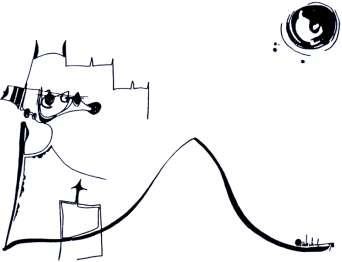
Courtesy: Nigeria Magazine. Vol. 55, No. 1
- Wonder and be curious: Budding practicing painters needs to do somethingprofessionally remarkable and desire to know more on the development of painting globally and locally. Artists must at individual and collective levels create unfamiliar, unexpected or inexplicable visuals and works. They must be able to create professional surprises, push professional boundaries and limits beyond the edge. Artists must desire and be curious to know and learn new things. They must visit art exhibitions locally and surf to know more about international expositions, art fairs and art shows globally.
- Be willing to take professional risks: Visual artists including painters of thisdecade must be prepared to take professional risks. They must be able to exercise limitless freedom of expression on the subject matter, techniques, materials, media, methods and so on in painting. Visual perception and tactile quality of any form in painting is advocated. Professional and academic
barriers must be broken. Both artificial and natural laws of drawing and painting could sometimes be suspended for the creation of something new. (Plate 8)
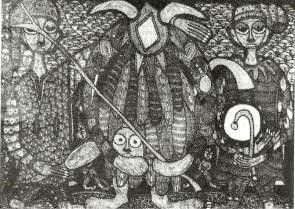
Oil & Ink on Sculptured Plywood, 1989
Courtesy: The Nigerian Artist of The Millenium by D. O. Babalola
- Advocacy for Indigenous Symbols and decorative forms: This studyfurther advocates the introduction of decorative forms at both the main image and the background of painting works. The motifs and symbols at the background of work must interact with the main. Application of meaningful local symbols, motifs, patterns and forms intentionally applied. A painting titled, „The Return of Our Mother‟ (Pate 9) is a good example. Decorative forms on the studio experiments could be collated from existing native patterns and decorations. In Nigeria, decorations are part of our social and religious life e.g the traditional priest – display in their shrines, costumes etc.
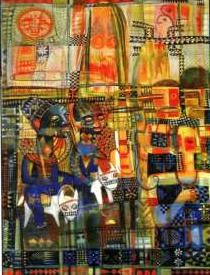
Courtesy: African Artists Foundation
Culturally, we are a decorative colourful cultural people. From the foregoing it is expected that our paintings, graphics, textile, architecture should exhibits this peculiarity. This decorative colourful attitude is supported by the African trend of modern living, fashion, textile, crafts, and architecture.
- Take advantage of accidental events: Practiced-led professional paintersmust give room for regular experiments or explorations in painting. They should equally take note and advantage of accidental results or events. This spontaneity most time becomes a celebrated development for the artists. (Plate 10) A case in point is the 1967 deep etching hydrochloric accident of Bruce Onobrakpeya. According to Elebute(2011)
The epoxy-base etching was, however invented in 1967 by a Nigerian born artist: Bruce Onobrakpeya, subsequent to the „Hydrochloric Acid Accident” at a workshop organised for art teachers by a dutch professor, Ru Van Rossem in Osogbo.
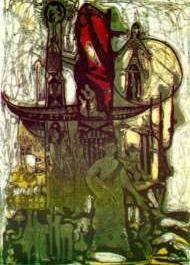
Courtesy: National Gallery of Art
Lawrence (1979) equally commented that the epoxy-base etching invented by Bruce Onobrakpeya started by chance. He notes;
After attending the Osogbo workshop, Onobrakpeya continued his trials with the intaglio prints with acid on zinc on copper plates…. After spoiling one plate, he tried to repair it by filling in
the unwanted holes and lines with resinous substances…. when
he produced a print from the altered plate, he noticed an interesting sculptural quality to it and went further to exploit this method in future experiments.
Going by the above statements and observations made by these scholars, it can be said that Osogbo workshop experiment influenced the development of Onobrakpeya‟s epoxy-base etching techniques. The hydrochloric acid accident became the discovery of a life time for Onobrakpeya. He subsequently has built a good visual art structure on it.
- Synthesize, Integrate and Find order in disorder: This study advocates aconscious effort in synthesizing, integrating and looking for order in disorder.
The 21st century Nigerian artists, must like their predecessors of the 20th century embark on a revolution of traditional materials, techniques and methods of their individual culture and environment with a view to synthesizing the rich heritage in a manifestation of new, modern art in Nigeria. This will help in no small measure to achieve identity in our cultural essence.
For example, in practising this philosophy, Nnadozie (2008) notes;
Onobrakpeya based on his Urhobo peoples‟ folktales, Yusuf Grillo‟s painting began to reflect the elegant geometrical or the mathematical forms of the Yoruba carving. Demas took his interest back to the Nok civilization while Uche Okeke, aware of a viable extremely eloquent form of artistic expression practiced among the Igbo of the South-East Nigeria, from antiquity, turned to this traditional art form for inspiration. The art form, Uli long practiced as body decoration and wall painting, possesses an extensive corpus of motifs varying from region to region yet reveals basic similarities and was widely distributed throughout Igbo land
- See the familiar from an unfamiliar point of view: Nigerian budding artistsand future painters should be able to see familiar objects, materials, compositions, sceneries, techniques and mediums they have been used to from an unfamiliar point of view. Sometimes, they should delimit objectivity and move to subjectivity in their approach. We should be bold enough to try our hands on paintings that will not give direct answers or interpretation to our audience. Instead we should be able to take our viewers through a visual thinking process that will be more challenging professionally. Painters approach to work could be explorative, satirical, metaphorical, ironical, surreal, impressive, expressive, abstractive, analytical, constructive, etc and still be classical in any of the style chosen. Dele Jegede‟s Niger Delta: Militancy III; a mixed media painting towed this line of thought (Plate 11). A
further change in style development, subject matter or theme, process or method of production, usage of materials and so on gives the artist a limitless measure of growth and development. However, in advocating for change, there must be consistency.
Photo: Dele Jegede
- Waste to Wealth Principles: Also, familiar cheap waste objects or thingshitherto meant for trashing could be converted to meaningful artists or painters materials. Bye products of some manufacturers or artists may sometimes be the needed raw materials of the artists. Some used and discarded tins, plastics, ornaments, shavings, fabrics are good assemblages for mixed media paintings. The use of carvers‟ shavings, metal, carbon black and charcoal from burnt wood etc may change the direction of some paintings produced by artists. This brings to fore the “waste to wealth” syndrome and the use of unconventional cheap, improvised and available materials for visual art expressions. In other words, improvisation and experimentation with new materials help to put in place new trends in easel painting.
- Produce or make one thing out of another by shifting its function: Thisstudy advocates the activation of the principles of originality by imitation in a way of having personal input into an existing product. By this method, barriers would be broken and the limit of the outcome of painting is once again shifted. The resultant effect and products are paintings that are neither mixed media nor traditional easel painting in technique, approach, media application with materials and methods. With these, the visual art world will be greeted with new painting vocabularies and languages. A good example is the Bruce
Onobrakpeya‟s innovation and experiment in printmaking that gave birth to plastography and plastocast as visual art vocabularies and language.
- Persistency: this study advocates the principle of persistency. Nothing goodcomes cheap and easy. Artists must be dedicated to the development of the profession. They must at all times exhibit sincerity, dedication, faithfulness and love for the profession. Younger and budding artists must be ready to work in studios for long periods – perhaps years of serious search in pursuit of a developmental goal in visual arts.
In conclusion, Evaluating this study on a broader perspective have shown that artistic activity is a form of reasoning, in which perceiving and thinking are indivisibly intertwined. A person who conceptualise, study, sketch, compose pictures, and paints, to this study, thinks with his senses. Therefore, Nigeria‟s budding visual artists must be willing and able to perceive, think, analyse, evaluate, verbalise and document their works. This will help to put some records straight, pass information and the development of painting to other stakeholders, and future generations. The notion of „art as a doing thing‟ syndrome which is operated in most Nigeria‟s school of art should be stopped and reviewed henceforth. Skill training alone has not helped the development and understanding of art appreciation and by extension stunted the growth and patronage of visual arts. Visual art curriculum in our art institution should emphasize the production of creative artists, thinkers, designers, etc., instead of copy artists as it is presently done. These schools of art should be mandated through their curriculum to give a rounded and balanced visual art education to the upcoming Nigerian visual artists, which include the theory and practice of art. In this light, positive art education aimed at producing responsibility driven personality whose moves catalyses sustainable development should be encouraged (Egonwa 2007). Artists must be in touch with subconscious sources, yet be intensely conscious. In this light, this study advocates that artists in a creative process must be inspired by an idea or faced with solving a problem. Thus, they must apply the sequential characteristics of creative processes which are; Preparation: which is a process of framing or formulating the question(s). Information is gathered and open-minded exploration is allowed to take place. Incubation: which means all the preparatory work is set aside and the artist or researcher allows intuitive insights come forward. Illumination: This is when a sudden accident or insight leads to a valuable final result. Verification or revision: This is when the final product or solution is tested and others respond by confirming or denying the success: Revision may sometimes lead the artist to begin the steps again. Lastly, many of the suggestions advocated in this study have innate potential to advance the limit of the present boundary of easel painting practice and reverse the decaying trend in Nigeria‟s present easel painting tradition.
References
Acton, M. (1999), Learning To Look At Paintings, Routledge, Frome and London: Butler and Tanner Ltd.
Adetoro, S.A. (1997), Research Techniques for Projects, Proposals, Reports, theses and Dissertations, (revised edition), Zaria: Ahmadu Bello University Press, Limited.
Adeyemi, K. (2005), Signs, Motifs, Symbols and Forms – A Glimpse at Nigeria‟s Democratic Stability, Catalogue of an exhibition of Paintings, Mixed Media,Drawings and Prints. Lagos: K.A Studios and Gallery Ltd.
Adeyemi, K. (2008), New Wine, Kunle Adeyemi Studio, Lagos, Nigeria: National Gallery of Art.
Dantini, M. (2008), Modern And Contemporary Art, New York, N.Y 10016: Sterling Publishing Co., Inc. 387, Park Avenue South.
Dike, P.C. & Oyelola, P.(ed) (1998), “Introduction” The Zaria Art Society, A New Consciousness, Lagos: National Gallery of Art.
Egonwa, O.D. (2005), African Art: A Contemporary Source book, (revised edition), Abuja, National Gallery of Art, Nigeria.
Egonwa, O.D. (2006), Nigerian Art in the 20th Century and the Limits of Motor Skills; Styles, Schools and Movements in Modern Nigerian Art; Proceedings of the 2nd National Symposium on Nigerian Art, Abuja: National Gallery of Art. Pp. 177 – 182
Egonwa, O. D. (2007), Writing about Art and Making Art in Nigeria: Many Legs how much Movement, Abraka: 14th Inaugural Lectures of the Delta State University.
Elebute, A. E. (2010), Bruce Onobrakpeya‟s Etching Techniques And The Agbarha-Otor Workshop Experiments, unpublished PhD Thesis in the Institute Of AfricanStudies, University of Ibadan, Ibadan, Nigeria.
Emeni, O. (2001), Changing Phases of Professional Painting Composition in Nigeria since 1960; Unpublished MFA Thesis in the Department of Fine and AppliedArts of the Delta State University, Abraka.
Emeni, O. (2005), Ideologies of Representation and Visual Languages in Contemporary Nigerian Painting 1920-2004, Unpublished Ph.D Thesis in Art History of theDelta State University, Abraka.
Fichner – Rathus, L. (2007), Understanding Art, New Jersey, Prentice Hall Inc.
Goldwater, R. (1979), Symbolism, New York, Harper & Row, Publishers, Inc.
Harrison, C. (ed) (1996), Modernism, Critical Term for Art History, Chicago & London: The University of Chicago Press Ltd. Pp. 142 – 149.
Jung, C. C. (1981), “Psychology Theory of Model” in New Age Encyclopedia Vol. 16, China: Lexican Publication.
Klaus H. (1992), “Loners or Anything Goes”? Contemporary Art, Germany: Taschen Publishers.
Nnadozie, U. (ed) (2008), Evolution of Art Movements and Schools in Nigeria: Nsukka School of Art evaluated, Styles, Schools and Movements in Modern Nigerian art, Nigeria: National Gallery of Art. Pp. 49.
Oloidi, O. (1995), Three Decades of Modern Nigerian Art, General Observation and Critique, USO: Nigerian Journal of Art, Volume 1, No 1, July-Dec., 1995, Lagos,National Gallery of Art, Surulere, Nigeria. Pp. 70–72.
Oyelola, P. (1980), Everyman‟s Guide to Nigerian Art, Nigeria Magazine, Department of Culture, Federal Ministry of Information and Culture, Lagos, Nigeria.
Preble, Duane and Sarah (1994), Art forms: An Introduction to the Visual Arts, New York, Harper Collius College Publisher.
Schneider, A. (ed) (2008), Reflection, Interaction, Interview: Art in the Megacity, Lagos:
Art Intervention in Public Space, Lagos: Goethe Institute. Pp. 10-11.
Shiff, R. (ed) (1996), Originality, Critical Term for Art History, Chicago & London: The University of Chicago Press Ltd. Pp. 103 – 109.
Visual Art in a Changing World (2011), Wikipedia Retrieved 1st July, 2011 fromhttp://en.wikipedia.org/wiki/changeart-terminology.html